In the high-stakes, ruthless world of American hip-hop, power is often measured not in albums sold, but in alliances secured and enemies silently crushed. For years, Nicki Minaj stood atop the pyramid, a self-made titan with an estimated net worth well over $150 million. She was untouchable—until, seemingly overnight, her empire began to crumble, the destruction marked not by a public scandal, but by a chilling series of financial maneuvers that appear coordinated, surgical, and absolutely merciless.
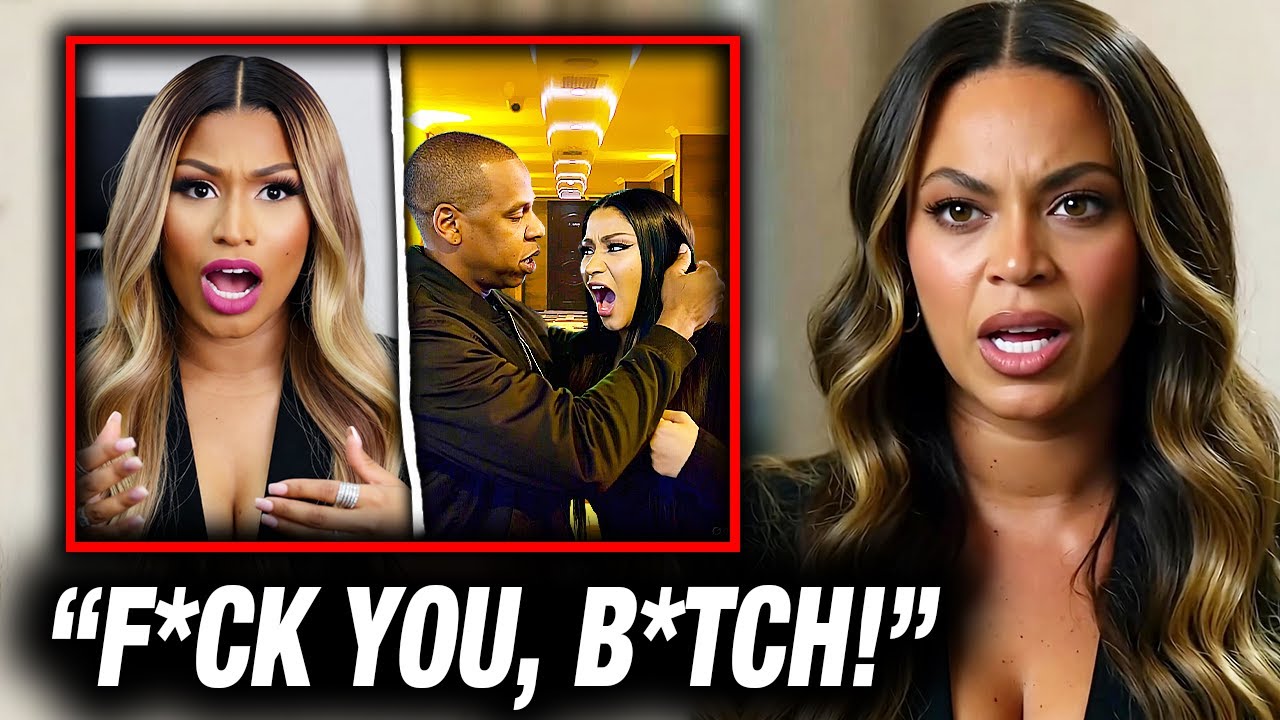
The core of the crisis is a bizarre, deeply humiliating juxtaposition: a global superstar facing the seizure of her $20 million Hidden Hills mansion over an unpaid $53,000 judgment. The debt, owed to a security guard from a 2019 incident, is a minuscule fraction of her wealth. Yet, her refusal or inability to pay has led to foreclosure proceedings, fueling her desperate, erratic, and viral online accusations that Jay-Z and Beyoncé—the industry’s most revered power couple—are actively plotting her financial and professional demise.
This is the story of an alleged coordinated takedown, a financial war waged by proxy, where silence is the deadliest weapon and the target is left fighting phantom forces until she is, in the words of an anonymous insider, “starved out.”
The Tidal Betrayal: A Fortune Forged in Silence, Lost in Betrayal
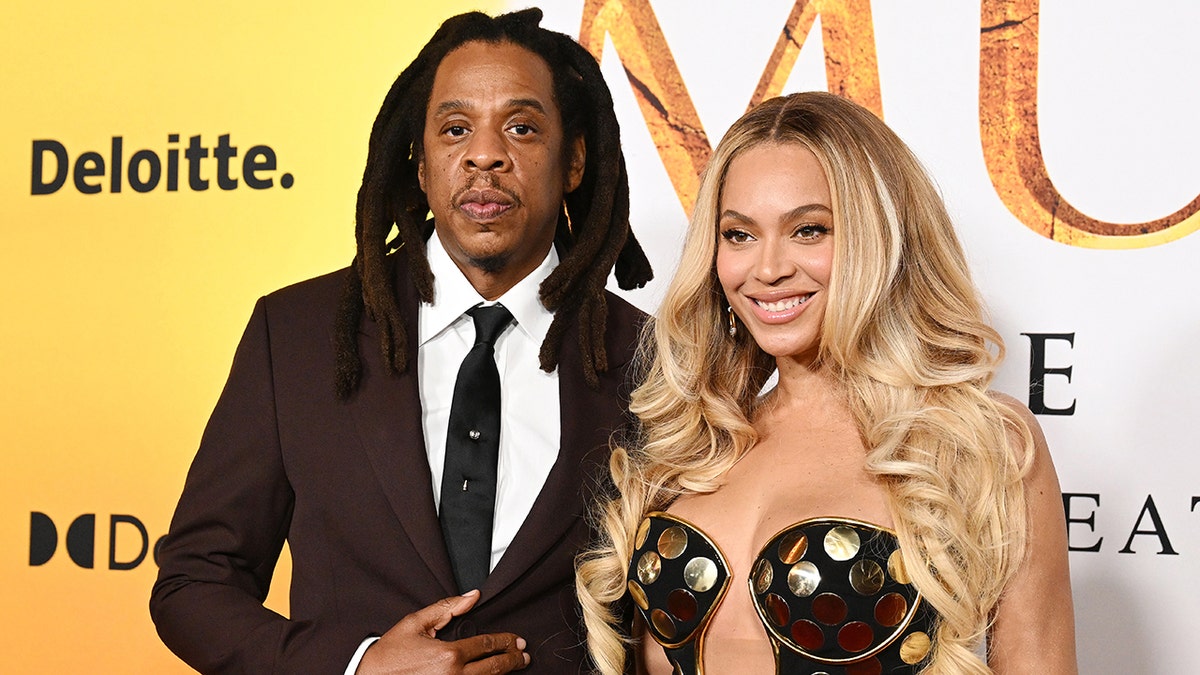
The roots of the current feud stretch back to 2015, a time when Nicki Minaj was inducted into Jay-Z’s inner circle of collaborators as a Tidal investor. The streaming service was launched with the promise of being an “artist-led revolution,” a rebellion against the corporate structures of the industry. Minaj was one of 15 artists gifted a 3% stake, appearing shoulder-to-shoulder with Jay-Z, Beyoncé, and Rihanna—a symbolic confirmation of her elite status.
But in 2021, the revolutionary façade dissolved. Jay-Z sold Tidal to Jack Dorsey’s Square (now Block) for a reported $300 million. While most co-owners quietly received checks and signed confidentiality agreements (NDAs), Minaj claims she was offered only $1 million for her stake—a pittance that infuriated her. She has since publicly compared the offer to her anticipated payout, a figure she suggests could have been anywhere from $89 million to $200 million, depending on the valuation structure she was promised.
The $1 million, she insists, was “hush money for silence.” This alleged disparity fueled her subsequent rants, where she accused Jay-Z and his company, Roc Nation, of manipulating valuations and distributing shares unfairly. When she dared to ask questions, she claims, her calls suddenly stopped being returned. This alleged corporate double-cross provided the motive; the financial isolation would provide the means for her alleged downfall. It established a narrative where her struggle wasn’t about incompetence, but about a targeted, strategic suppression.
The Humiliation of the Half-Million Debt
The sheer absurdity of the foreclosure proceedings against a star of her magnitude is central to the entire narrative. On October 6th, 2025, a security guard named Thomas Widen Müller, who claims he was assaulted backstage at one of her 2019 Germany shows, filed a motion to collect on a $53,000 judgment he was awarded. When his lawyers couldn’t collect the relatively minor sum, they did the unthinkable: they asked the Los Angeles Superior Court to force the sale of her $20 million Hidden Hills home.

The legal filings made it abundantly clear that the home held millions in equity, more than sufficient to cover the debt. Yet, the star, with a net worth of nearly $200 million, had failed to pay it. To insiders, this failure was not an oversight; it was the chilling effect of an alleged financial chokehold. Sources close to the situation claim that Roc Nation executives allegedly discussed a strategy to “starve her out,” leveraging their vast network to pressure creditors and limit her cash flow. The intent, according to one anonymous source, was not to cancel her deal, but to make her financial existence impossible, forcing her to sell assets at a loss or retreat entirely. The $53,000 judgment thus became a corporate weapon—a tiny lever used to topple a giant, exposing her vulnerability in the most public and humiliating way possible.
Beyoncé’s Invisible Hand: Toxic Behavior and Brand Isolation
While Jay-Z allegedly pulled the financial levers, insiders claim Beyoncé managed the public image fallout, acting as the “silent force” protecting the sanctity of the Carter brand. The alleged catalyst for her involvement was Nicki Minaj’s increasingly erratic social media behavior, which culminated in a string of disturbing rants where she allegedly mocked Jay-Z and Beyoncé’s children, even using their names to taunt her rivals.
For the famously private and image-conscious Beyoncé, this was the red line. Industry sources claim that her management at Parkwood Entertainment began quietly making calls to sponsors, event organizers, and collaborators in early September, urging them to avoid Nicki-related projects. The message, though polite—”it’s not the right fit this season”—was a death knell for a star whose income is heavily reliant on endorsements and public appearances. Major brands, desperate to maintain their relationship with the Carters, quickly fell in line.
This strategy marked a decisive pivot: financial pressure coupled with professional isolation. Sponsors paused endorsement deals worth millions, and award committees reportedly withdrew early invitations. The industry executive who spoke on the condition of anonymity put it bluntly: “No one wants to be the brand standing next to her when she explodes.” By isolating her, Beyoncé’s alleged actions transformed her from a powerhouse collaborator into a toxic liability, ensuring that her financial woes would spiral with no professional lifeline to catch her.
The Petty Problem: Weaponizing a Volatile Past
The financial and professional pressure was compounded by a third, deeply personal element: the recurring legal troubles of her husband, Kenneth Petty. In September 2023, Petty was ordered to serve 120 days of house arrest for violating probation by posting videos that featured threats against other rappers. These clips reignited public scrutiny of Petty’s dark history, including his 1995 attempted assault conviction and his ongoing civil suit with Jennifer Huff, the woman he assaulted.
Sources aligned with the Roc Nation narrative allege that this resurfacing of Petty’s past was not accidental. They claim that Jay-Z’s extensive PR network ensured that old video footage and headlines detailing Petty’s criminal record and the harassment allegations were pushed back into rotation just as Nicki’s legal and financial issues were heating up. The timing was uncanny, and the effect was devastating: it diverted attention from the complex Tidal money dispute to the simpler, more easily digestible narrative of Nicki Minaj being tied to a violent and problematic individual.
The exploitation of Petty’s volatility served two purposes: it kept Nicki tethered to her home during house arrest, unable to fully engage in her financial defense, and it further cemented her public image as a toxic entity. As the lawsuits from former employees and security staff stacked up, Petty’s past became the public-facing liability that justified the corporate distancing.
Cornered and Crying: The Desperation of the Queen
Facing financial catastrophe, professional isolation, and a personal life tied to controversy, Nicki Minaj’s response has been one of increasing desperation and erratic behavior. Her social media tirades have swung wildly—from spiritual meditations one day to direct, vulgar accusations against Sean Carter the next. She has accused the media of a “smear campaign” and claimed that the entire industry “wants her quiet.”
Her internal turmoil peaked with the announcement that she was canceling her album, only to retract the statement within 24 hours, promising a “Billionaire Barbie” era. This contradiction speaks to a star under immense pressure, making power plays from a position of vulnerability. Her refusal of a Roc Nation tour and album partnership—a seemingly defiant act—is read by insiders as an act of desperation, her last form of control against an invisible system she claims to be profiting from her silence.
The ultimate question remains: what was Nicki Minaj truly trying to say before the invisible hand tightened its grip? Was it merely anger over the lost Tidal millions, or, as she hints, does she possess knowledge about the inner workings of Roc Nation that would reveal a system of control far darker than the public imagines?
While Jay-Z and Beyoncé remain strategically silent—a silence that speaks volumes in its calculated indifference—Nicki Minaj is left fighting alone. Her collapse feels orchestrated, a textbook example of how a modern celebrity empire can be dismantled from the inside out. It is a cautionary tale about the true currency of power, where $200 million in alleged owed debt can be overshadowed by a $53,000 financial maneuver, and where the most powerful figures in music can allegedly deploy a corporate arsenal to ensure that one defiant voice is finally, permanently, silenced.